Every buyer asks about flow rate. “How many litres per minute does this drain handle?” is the first technical question on most shower-drain RFQs. And if a supplier says their product meets EN 1253, you might assume that standard sets one clear flow number. The reality is more nuanced — and more useful once you understand it.
This guide explains what EN 1253 says about flow (water discharge), why there is no single magic number, and how to read and verify the L/min figures a supplier gives you. It is the missing piece that connects the water-supply side of your shower to the drain on the floor.
Flow Rate as a Performance Requirement
EN 1253 covers gullies (floor and shower drains) for buildings, and among its performance requirements is water discharge — the drain’s ability to carry away water. As with other properties such as load and odour tightness, this is a tested requirement, not a marketing figure. The specific discharge that must be met depends on the product type and class, which is why two different drains answers “what flow?” differently.
The practical point: when someone says a drain “meets EN 1253,” that claim includes flow performance — but the relevant level is tied to the specific product and its intended application, and it should be verifiable through the test method defined by the standard.
Two things help avoid confusion. First, EN 1253 flow figures are measured under defined test conditions (a specified water head and set-up) — they are not an absolute on-site number, because real-world performance also depends on outlet size, pipework, gradient and installation. Second, watch the unit: test requirements are often expressed in litres per second (L/s), so 0.4 L/s equals 24 L/min. In short, do not compare your shower’s supply flow directly with an EN 1253 test value as if they were measured the same way — the two figures describe different parts of the drainage system.
It also helps to separate two things: an EN 1253 minimum test requirement is one thing; a manufacturer’s product flow figure is the tested performance of an individual model under specified conditions. Compare both against the requirements of your project.
Why Flow Matters on the Floor
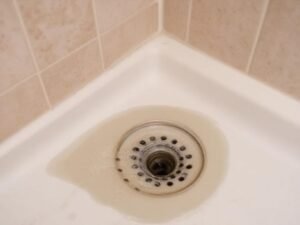
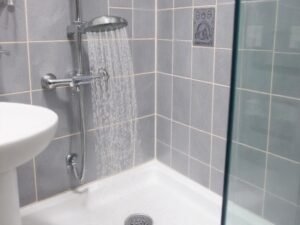
Flow is not an abstract number. It decides whether a shower drains cleanly or leaves you standing in water. A wet-room or walk-in shower with a large rain head can deliver water faster than a tiny drain can clear it, and if the drain can’t keep up, you get pooling, slippery floors, and in commercial settings, unhappy guests.
So the real question when choosing a drain isn’t “what’s the biggest number you have?” It’s “what flow does my shower actually produce, and does the drain clear it with headroom?”
How to Read a Supplier’s Flow Figure
Not all flow figures are created equal. A reliable one comes with a test method behind it. When you compare L/min numbers, ask:
- How was it measured? A tested figure from a flow rig is engineering; a quoted number with no method is sales.
- Is it the drain’s tested capacity, or a supplier estimate?
- Does the figure relate to the specific model and fitting you’re buying? Channel length, outlet diameter and installation all affect real-world performance.
Treat a flow number the way you would a load rating or an EN 1253 odour claim — verify it, don’t assume it. Our dedicated EN 1253 compliance guide walks through the verification approach in detail.
Matching Flow to Your Shower
A practical way to size flow is from the supply side: a typical shower head delivers on the order of 6–12 L/min, an overhead rain head more, and multiple heads more still. Your drain should comfortably exceed that combined supply, so peak shower flow never stalls on the grate.

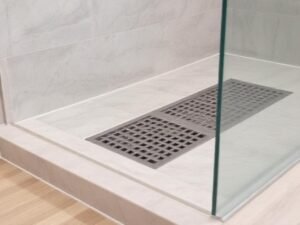
Across our linear drain range, tested flow runs roughly 20 L/min on standard models, up to around 45 L/min on our premium FR and S01 series, with an overall range of about 20–60 L/min and custom options beyond. Whether that is enough depends on your shower flow and installation — which is exactly why we size the drain to the project.
Flow, Verified Like Every Other Requirement
Because flow is measured under defined test conditions, treat a product’s tested L/min as the drain’s capability under those conditions — and make sure your project’s outlet, pipework and gradient let it be realised. Compliance documentation ties the tested figures together for your market.
When you source, ask for the tested flow of the exact model, how it was measured, and the relevant documentation. Paired with the right load class and anti-odour design, that gives you a drain you can spec with confidence.
Spec a Drain That Actually Keeps Up
EN 1253’s flow requirement is there for a reason: drains that can’t keep up fail the bathroom. The fix is choosing a drain whose tested flow clears your shower’s real output with headroom — and verifying the number rather than trusting it.
Tell us your shower configuration — heads, expected flow, and drainage setup — and we will recommend the right shower drain for your project, with the tested flow data and a free sample to verify yourself.